What Is an Erwartungshorizont? A Parent's Guide to Understanding Grades in German Schools
Maria · State-recognised public-school teacher · 17 years teaching German.
Your child brought home a German or maths test with a disappointing grade? Learn what an Erwartungshorizont shows, what to ask the teacher, and how to practise the right skill.
Your child studied, but the grade doesn't show it. What did the teacher expect?
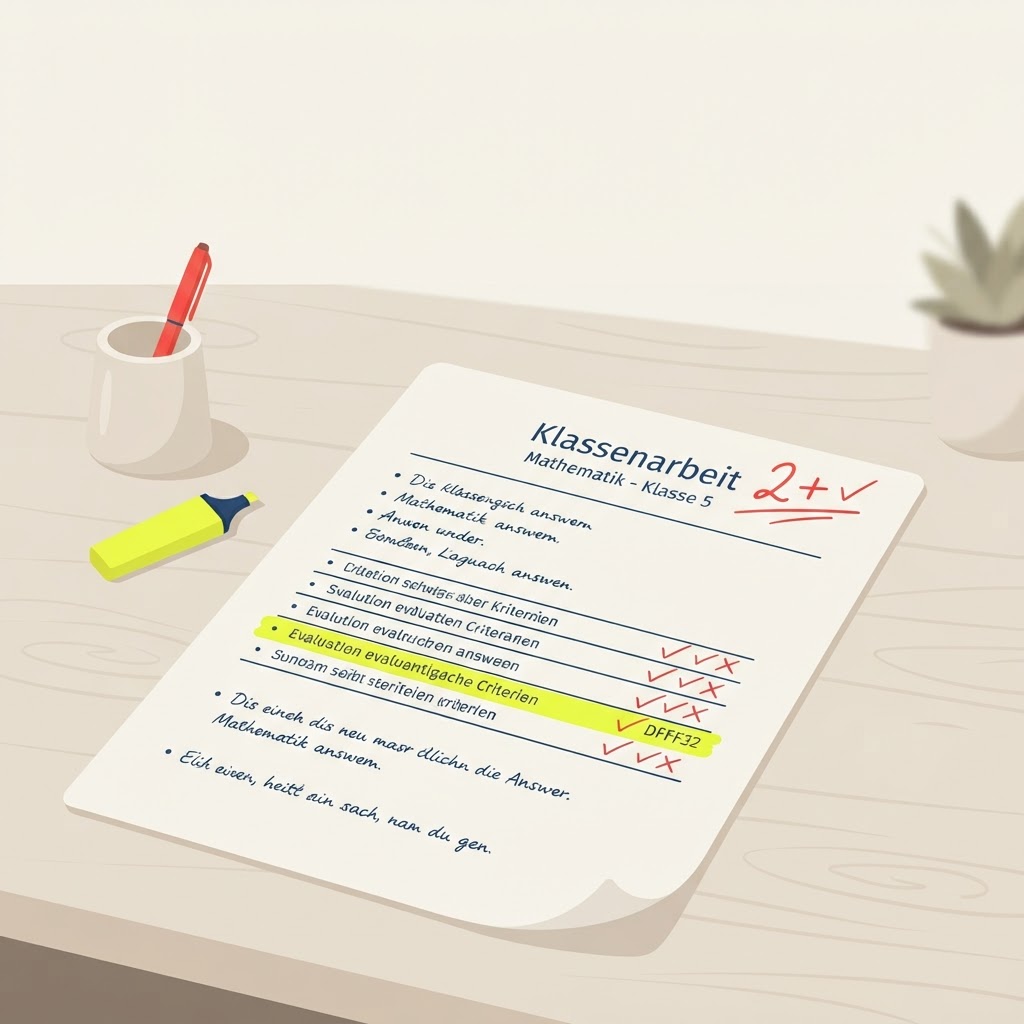
In German schools, you may hear the word Erwartungshorizont. It means the criteria used to judge an answer: what the child needed to show and how points could be awarded.
The grade tells you how your child did. The Erwartungshorizont helps you understand why.
In German, your child may understand a text but lose points because the question asks them to begründen — give a reason and support it with evidence. In maths, a child may reach the correct answer while the task also asks them to show their Rechenweg, or method.
Three terms worth knowing
- Erwartungshorizont: What an answer is expected to demonstrate, sometimes with criteria, example answers and points.
- Musterlösung: A sample solution.
- Notenschlüssel: How the total points translate into a grade.
These documents can look different from school to school and from task to task. Don't assume that every corrected Klassenarbeit will come home with a separate Erwartungshorizont. What matters is that you can understand where your child gained and lost points — and what they can improve.
What should you ask the teacher?
"Could you show me the assessment criteria or an example answer, and help me see where my child lost points? I'd like to know what they should practise next."
Then look at one corrected paper together. Did your child misunderstand the instruction? Know the answer but struggle to explain it? Miss a maths step? That tells you far more than the grade alone.
A practice book can help with the missing skill. It cannot tell you the exact criteria for your child's next test. For that, start with the task, the corrected paper and the teacher's feedback.
If the feedback still doesn't explain why your child's grades lag behind their effort, explore the Warum-Check.
Where can I find official examples?
Education in Germany is organised by the 16 federal states. Each one publishes its own curricula and — where available — example tasks and assessment criteria, so the relevant materials are the ones for your Bundesland rather than a single national set.
Not every state publishes example Klassenarbeiten publicly, and what is published differs by school type and grade. Where nothing is available, ask your child's teacher which criteria were used for the task in question. That is the most reliable answer in every state.
What does your Bundesland publish?
Education in Germany is organised by the 16 federal states, so example tasks, criteria and marking guidance differ from state to state. Choose yours to see what its education authority publishes.
General guidance
Not every state publishes example tasks and marking criteria publicly, and what is published differs by school type and grade. Nationally, the KMK Bildungsstandards describe the competences each subject must build — the reference behind every state curriculum. For a specific result, the most reliable source is always your child's teacher: ask which criteria were used and where the points were lost.
KMK Bildungsstandards (applies in all 16 states)These are published examples, not the marking guide for your child's own schoolwork. To understand a particular result, ask your child's teacher about the criteria used and the feedback given for that task.
Want to see what an Erwartungshorizont actually looks like?
Enter your email address and we'll send you the free AYKEN guide with illustrative German and maths examples, a question to ask your child's teacher, and books chosen for different learning needs.
We use your email address to send this guide. The newsletter is a separate, optional choice. Read our privacy policy.