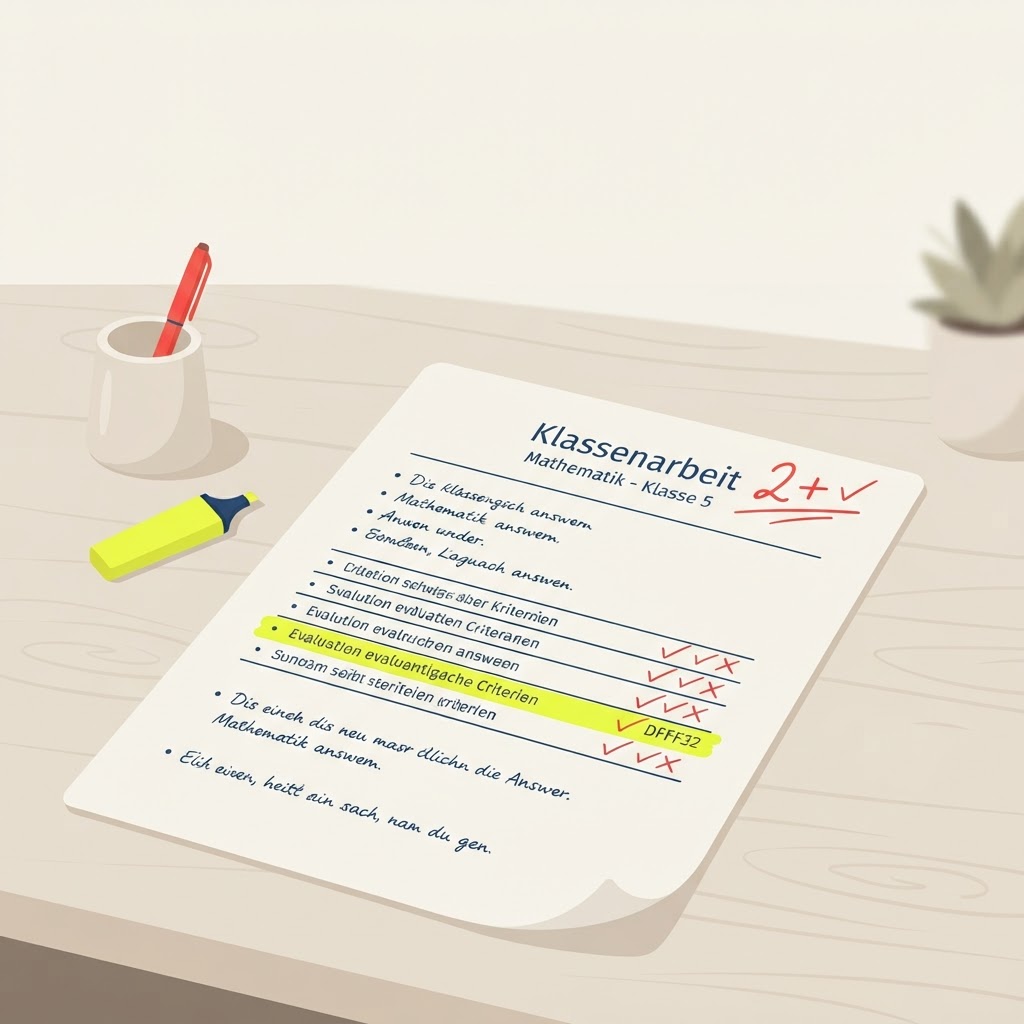
What Is an Erwartungshorizont? The Marking Sheet Behind Your Child's Grade

German teachers mark written work against a marking scheme most parents never see. Here's what an Erwartungshorizont is, what it contains, and how to use it to understand — and improve — your child's results.
Your child comes home with a test. The grade is a 3, the paper is covered in red ticks, and at the bottom there is a mark you cannot quite follow. You ask what went wrong and get the answer every expat parent knows: "Die Antwort war nicht vollständig." — The answer was not complete.
Complete compared to what? In German schools, that question has a written answer. It is called the Erwartungshorizont.
What an Erwartungshorizont Actually Is
An Erwartungshorizont — literally "expectation horizon" — is the document a teacher prepares before marking a test or exam. It states what a full-mark answer must contain, broken down task by task.
It is not the test itself. It is the marking scheme that sits behind it: the points available, the content required, and often the wording or structure expected.
Teachers are expected to be able to explain, on request, exactly what a task was worth and why. A corrected test may not come with a separate marking guide, though — if it doesn't, ask the teacher which criteria were used and where your child gained or lost points.
Why This Matters So Much for Expat Families
Most parents judge schoolwork by the result: right or wrong, good grade or bad grade. German written work is assessed differently — against criteria.
That creates a gap for children who grew up outside the German school system:
- A child may know the answer but not present it in the form the Erwartungshorizont requires.
- A child may answer partly correctly and still lose most points, because the marking scheme awards points for structure, evidence, or terminology.
- A child may write a lot and score low, because length is not what is being rewarded.
This is where the sentence "nicht vollständig" comes from. The content was there in the child's head. It did not appear on the page in the expected form.
What an Erwartungshorizont Usually Contains
The exact format varies by school, subject and state, but the core elements are consistent:
- The expected content — the facts, arguments or observations that must appear for full marks.
- The point distribution — how many points each part of the answer is worth, sometimes in Verrechnungspunkten (VP).
- The required form — whether the answer needs a full sentence, a quotation from the text, a specific structure, or subject terminology.
- The requirement level — which Anforderungsbereich (I, II or III) the task sits in, from reproducing knowledge up to evaluating and transferring it.
A task worth three points is not asking for the same thing as a task worth eight. The Erwartungshorizont makes that visible.
How It Connects to Operatoren and Anforderungsbereiche
The Erwartungshorizont does not stand alone. It works together with two other instruments:
- Operatoren — the official task verbs such as nennen, erklären, begründen, erörtern. Each one prescribes what the answer must do.
- Anforderungsbereiche — the three requirement levels that decide whether a task is testing knowledge, application, or evaluation.
Read together, they explain almost every grade a child receives in a written test. Erklären in Anforderungsbereich II cannot be answered with a list. Erörtern in Anforderungsbereich III cannot be answered with a definition.
When a child answers with the wrong task verb, the content can be correct and the grade still low. That is not unfairness. It is the marking scheme doing its job.
What Parents Are Allowed to Ask For
You do not have to accept a grade you cannot follow. In most German states you are entitled to:
- Ask the subject teacher how the test was marked and what the expected answer contained.
- Request written feedback on a specific task.
- Ask for a review of the marking (Überprüfung der Bewertung) if you believe points were awarded inconsistently with the scheme.
- Raise the question at the Elterngespräch or, if unresolved, with the class teacher or school leadership.
A calm, specific question works far better than a complaint: "Können Sie mir den Erwartungshorizont für Aufgabe 3 zeigen?" — Could you show me the expected answer for task 3?
Teachers are usually willing to explain. Most parents simply never ask.
How to Use It at Home
Once you understand what the marking scheme rewards, preparation changes:
- Read the task verb first. Before writing, your child should know whether the task asks them to name, explain, justify or evaluate.
- Practise the answer form, not just the content. A full sentence, a reason, a quotation from the text — the form carries points.
- Check against the criteria. After a test, go through the marked paper together and identify which criterion lost the points: content, structure, language, or terminology.
- Prepare for the announcement, not just the topic. Transparenz vor der Klassenarbeit — knowing the format and the criteria in advance — is part of preparation.
Children who understand how they are being measured stop guessing. They start working with the system instead of against it.
Where AYKEN Fits In
Explaining German marking instruments is exactly why we built the Teacher Tools collection in the Parent Library: Erwartungshorizont, Operatoren, Anforderungsbereiche, Bewertungsraster and more, written for parents rather than teachers.
If you want to see the instruments your child's work is measured against, start there. And if you are unsure how your child's own schoolwork is being assessed — or which skill should come first — the Warum-Check gives you a clear picture and priorities for what comes next.